
From the archive
Emotion and Conservatism: Edmund Burke vs. Jordan Peterson

“Similar to Peterson’s argument that happiness is not the sole purpose of life, Burke claims that the ‘pain’ the sublime instills in us is extremely helpful.”
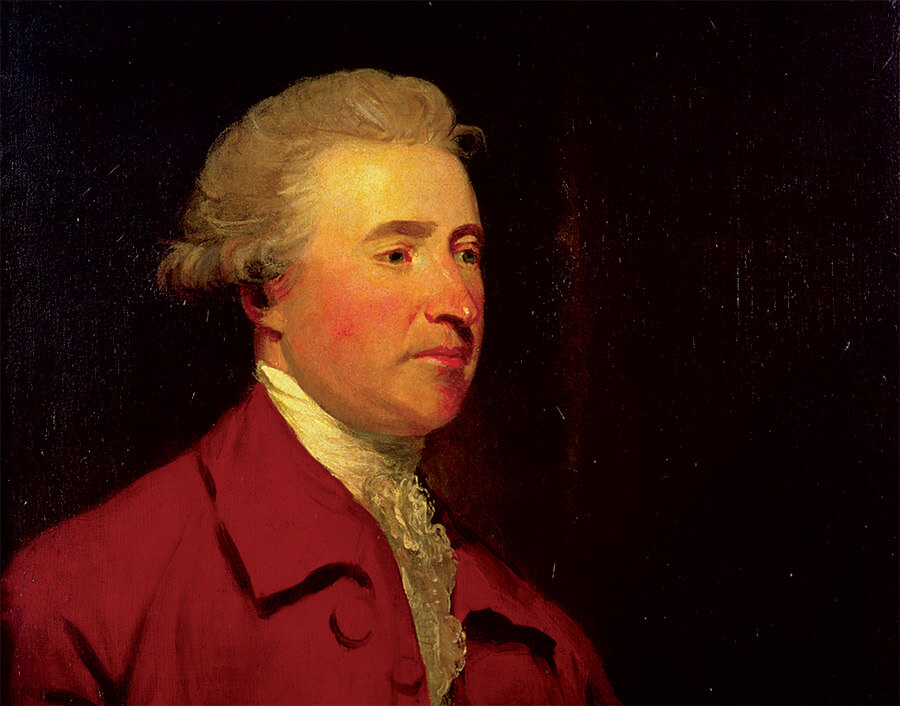
“Similar to Peterson’s argument that happiness is not the sole purpose of life, Burke claims that the ‘pain’ the sublime instills in us is extremely helpful.”
Introduction
One of the more frequent contemporary claims made by conservatives is that, in contrast to their left-wing opponents, they take the world as it truly “is” rather than as their emotions dictate it should be. Perhaps the most artful expression of this sentiment is Ben Shapiro’s slam against progressives that “facts don’t care about your feelings,” which has become something of an unofficial koan to followers of the so-called Intellectual Dark Web. Putting aside the questionable nature of this claim (does any political movement claim not to care about how the world “is”?), I also think it does a considerable disservice to the rich history of conservative thinking on the nature of emotions.
Indeed, a closer look at what Roger Scruton calls “the great tradition” demonstrates that it is full of figures who frequently castigated the Left for its uncaring rationalism and indifference to the concrete and affective experiences of the individuals they professed to care for. As I discussed elsewhere at Merion West, I think the claim that conservatives take the world as it “is” while progressives interpret it through the lens of feelings misrepresents the major dispute. Following Russell Kirk, I think instead the key difference is that it is, in fact, progressives who ask whether and what something “is,” while historically conservatives have asked what something “means.”
Two thinkers who implicitly recognize this are Edmund Burke and Jordan Peterson. Burke is often held up as the father of Anglo-American conservatism, and Jordan Peterson is a self-described classical liberal who, as I argued elsewhere, is perhaps best understood as a defender of “ordered liberty.” Both of these figures made a name for themselves criticizing the radicals of their day, though I would contend Burke was more skilled and even-handed in this respect than Peterson. Curiously, both authors emphasize emotion and affective attachment as central to their outlook on both life and politics. In particular, they place a central importance on fear as a key emotion for understanding both their sense of cosmological and theological grandeur, and they exhibit reticence in embracing radical solutions in the world of politics. I will compare both of their positions in this essay before concluding with the problems which arise from emphasizing fear as the primary political emotion.
Edmund Burke on the Sublime
Edmund Burke is a difficult figure to summarize in large part because his work deliberately avoided systematicity. In contrast to the “abstract” reasoning of Rousseau and later the Utilitarian rationalists, he was always keen to emphasize that human beings are emotional creatures who have to be understood historically and contextually. This meant recognizing the importance of the unconscious but extremely important background traditions and affective practices, many of which cannot be fully explicated through reason, which nevertheless govern a great deal of our actions. These background traditions and affective practices provide us with a sense of meaning—and therefore an orientation—that a purely rationalistic outlook cannot. Indeed, he goes so far as to dismiss proto-evolutionary and mechanistic attempts to reduce our understanding of these traditions and practices to scientific explanation:
“I am afraid it is a practice much too common in inquiries of this nature to attribute the cause of feelings, which merely arise from mechanical structures of our bodies or from the natural frame and constitution of our minds, to certain conclusions of the reasoning faculty on the objects presented to us; for I should imagine that the influence of reason in producing our passions is nothing near so extensive as it is commonly believed.”
The rest is for members.
All proceeds go toward publishing more writers and poets.
Free for 30 days, then $3 a month
Become a member
This work is preserved in Merion West’s archive of articles and poems published from 2016 through early 2025. Explore the archive