
From the archive
Engineering Morality in the Age of Driverless Cars
Once the realm of ivory tower thought experiments, the trolley problem is increasingly relevant in the real world as algorithms replace the human behind the wheel, argues philosopher Jimmy Alfonso Licon.
I am a philosophy professor tasked with teaching various ethics classes. A staple of introductory ethics is the famous thought experiment known as the trolley problem. In the classic scenario, a decision maker is faced with a runaway trolley headed down a track where it will kill five innocent people if he does nothing. However, he can flip a switch that diverts it onto another track, killing just one innocent person instead. There is no time to save everyone—the trolley is too close—so he must decide: allow five people to die, or actively intervene and cause the death of one person. This scenario pits the moral intuition that we should never intentionally kill against the intuition that we ought to save the greatest number of lives possible.
Trolley problems have caused countless students (and professors) to sweat over the difficult moral trade-offs they illustrate. One of the most common questions I hear—besides “Is this going to be on the test?”—is about the practical value of these abstract thought experiments. When pressed, moral philosophers usually explain that trolley problems serve as useful tools for testing and refining our ethical intuitions and theories. There is value in that, much like how thought experiments in science help clarify complex ideas.
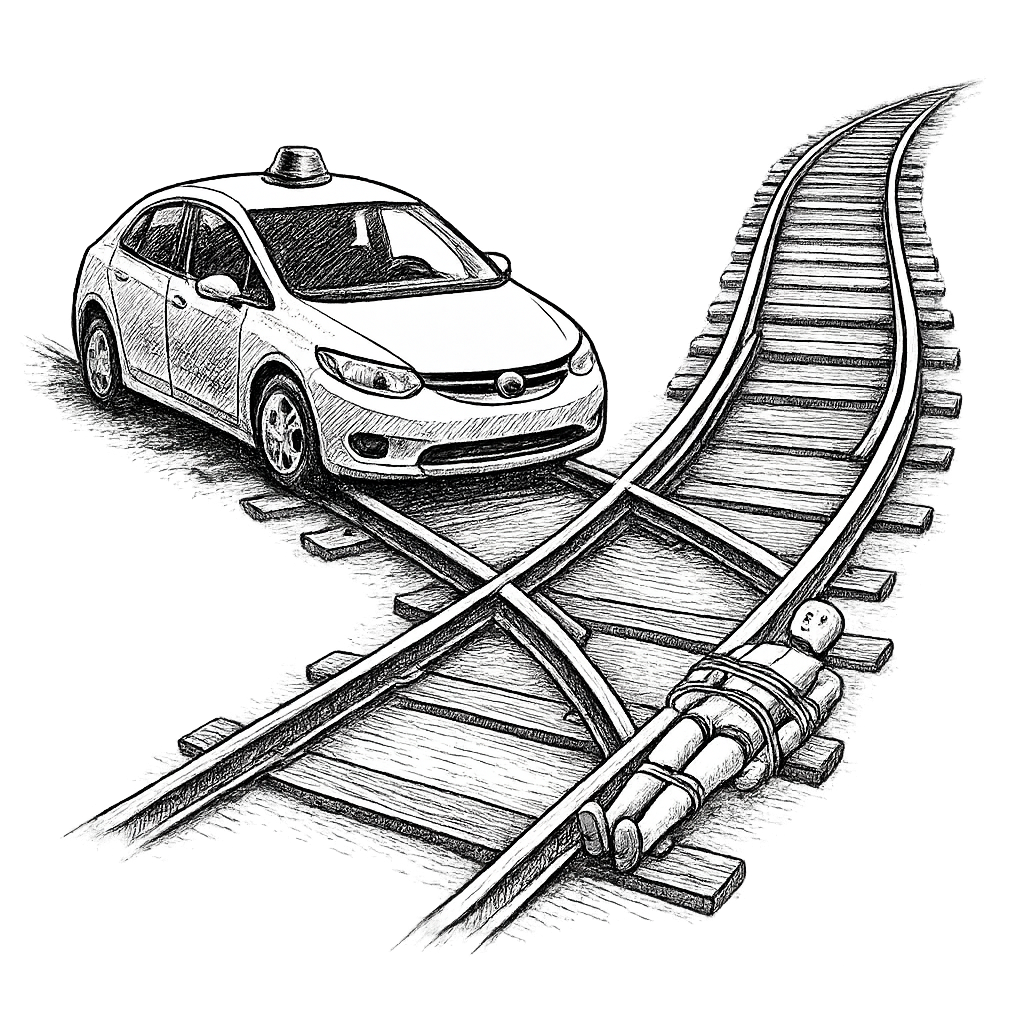
However, that is still a bit abstract. There is a more practical and immediately relevant reason to take trolley problems seriously: They can help us understand how our self-driving cars should behave in life-or-death situations. In most everyday driving, the question of whom one’s car should kill is not relevant, thankfully. Yet there will be rare but significant instances when a self-driving vehicle must make moral calculations akin to trolley dilemmas.
Imagine a scenario in which a self-driving Tesla recognizes that a serious accident is unavoidable. It calculates two possible outcomes: it can crash into pedestrians, killing them but saving the driver; or, it can crash into an obstacle, killing the driver but sparing the pedestrians.
The rest is for members.
All proceeds go toward publishing more writers and poets.
Free for 30 days, then $3 a month
Become a member