
From the archive
Dangerous, Dirty, Violent and Young: The Pull of Radicalism
In Zayd Ayers Dohrn's book, he recounts his childhood as the son of two prominent members of the Weather Underground. Allen M. Hornblum considers what draws young activists toward revolutionary violence—and contrasts that path with those who pursued social change nobly and peacefully.
Here I was on a train, absorbed in a fascinating account of growing up on the run as the son of two notorious American radicals, on my way to a memorial service for another political activist, George Gould. Unlike the author's parents, Gould, the dedicated Community Legal Services (CLS) lawyer whose life was being celebrated in Philadelphia, was not a dangerous radical. He had eschewed violence as a way to achieve his political goals. Instead, Gould had chosen to work within the democratic system and never considered bombing his way through it.
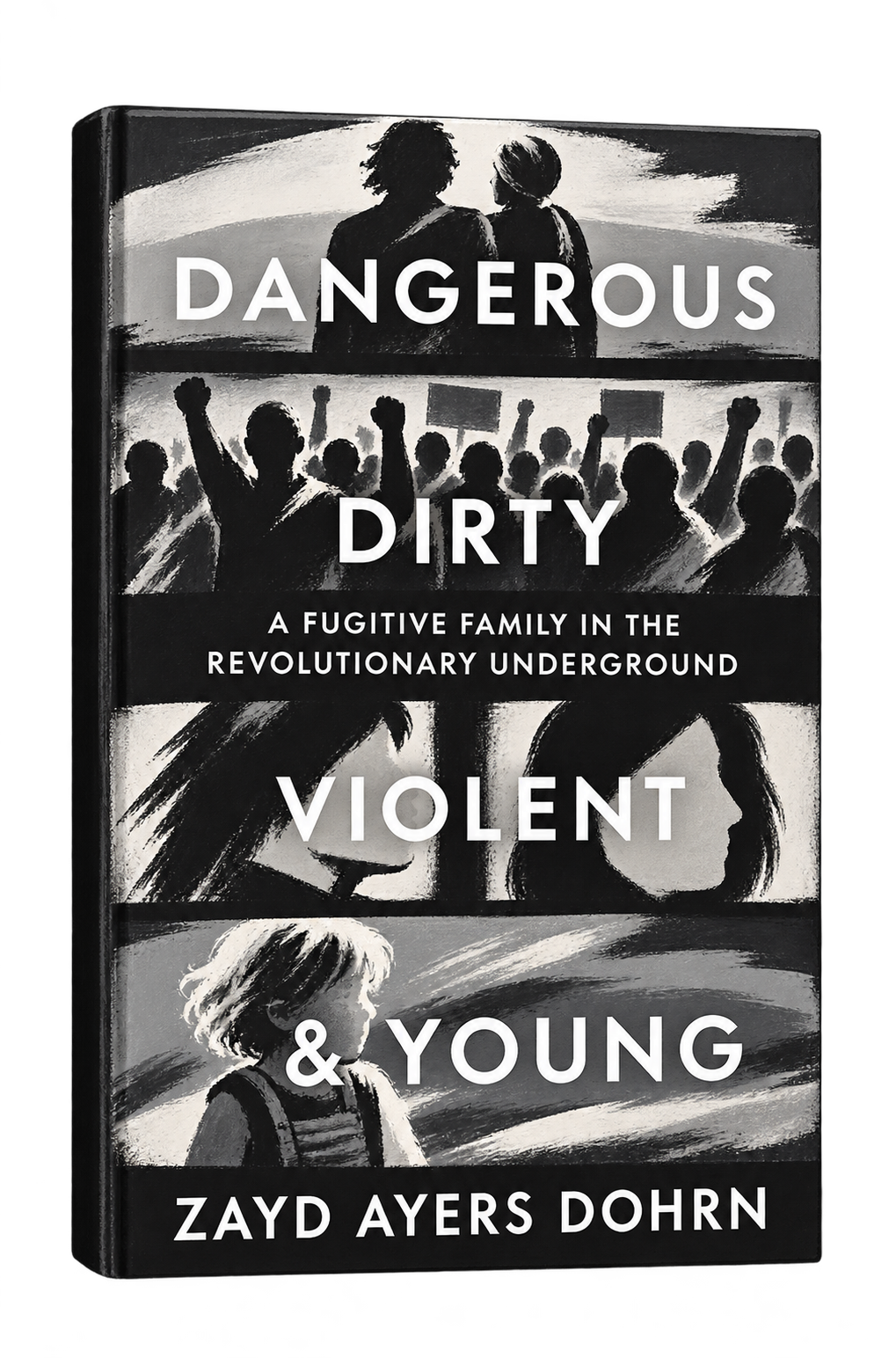
Zayd Ayers Dohrn's Dangerous, Dirty, Violent & Young, which was released in May, is a sensitive and sobering account of the unusual, fugitive childhood experienced by a young boy whose infamous Weatherman parents—Bill Ayers and Bernardine Dohrn—were sought by the Federal Bureau of Investigation (FBI) and law enforcement agencies across the country. Dohrn, now forty-nine years old and a successful playwright and podcaster, recounts his time “underground,” learning about what a strange and dangerous world his militant parents had created for him. He opens his compelling memoir by describing not how he was taught to grip a tennis racket or throw a baseball but, instead, how to
recognize plainclothes police officers and undercover agents in a crowd, to make calls from a payphone and speak in code, to walk in a complicated mix of turns and switchbacks to lose a tail, and watching from a rooftop or a fire escape to make sure our aboveground friends weren’t being trailed…
“In our circle,” Dohrn readily admits, “pretty much everyone we knew was a fugitive.” The lives of a good many of these fellow “soldiers” would end violently or in long prison terms.
Fortunately, very few of us come into this world with a parent who had been on the FBI’s Most Wanted List. Nor do said parents proffer themselves as “freedom fighters” in a country with “a hidden, savage past” and a violent present that could only be “dragged into a better future through acts of armed rebellion and suicidal sacrifice.” The author’s parents were two of the best-known and most celebrated or reviled activists, depending upon one’s political proclivities. Bill Ayers, the son of a corporate executive, grew up in a traditional Republican household, was educated at an elite boarding school on Chicago’s North Shore, and then attended the University of Michigan. He was in college when the 16th Street Baptist Church in Alabama was bombed. The killing of these four young black girls and the many sit-ins, protests, and marches that followed sparked Bill’s interest in America's painful history when it comes to race.
No longer “blissfully unaware” of the nation’s deep-seated racial animus, Ayers was motivated to do something. And he did, heading South to "join the fight."
Bernardine Ohrnstein, the author’s mother, was from less comfortable suburban Wisconsin circumstances, and her father’s unrealized ambitions were placed on her shoulders. (To help ease the family’s climb toward respectability and the “American Dream,” Bernardine’s father changed the family name from Ohrnstein to Dohrn.) After an unsatisfying year at Miami University in Ohio, Bernardine transferred to the University of Chicago in 1961, seeking a more stimulating intellectual environment. As Dohrn writes, his mother “wanted an adventure. She wanted to grow up and do something with her life.” She, too, thought more about racial injustice in the United States, the murders of Goodman, Schwerner, and Chaney, and the increasing number of college students going south to combat racial discrimination. “Civil rights,” as Dohrn says, became “the calling of a generation.”
She was not fully committed, however. Instead of making the risky trip south for Freedom Summer, she entered the University of Chicago Law School in 1964. But she did embrace Martin Luther King Jr.'s effort to address housing injustice in Chicago, and she soon became a valuable volunteer and legal resource during King's strategy sessions. The proximity to civil rights leaders and her increasing role in an important public policy campaign energized her. “It was all so powerful and so brilliant,” she admitted. “It changed my life.”
Bernardine joined Students for a Democratic Society, an organization that was becoming increasingly active in opposition to the war in Vietnam. Young and impatient, she clearly wanted to make a difference. As Dohrn says of his mother, “It wasn’t a game for her…she embodied a rage and defiance that spoke to the mood of the moment.” It did not hurt, recalled one colleague, that she was “a stunningly attractive woman. Bisque skin, brown eyes, a full figure [with a] strong-jawed sensuality and look of sultry defiance.” Her impatience and defiance were only heightened by King’s assassination. For her, this was the radicalizing event of her life.
With political turmoil and social unrest rapidly escalating both at home and abroad, Bill Ayers, Bernardine Dohrn, and the other young people demanding change convinced themselves
their parents’ worldview of hard work, prosperity, patriotism, and family had failed them. They were determined to break from their youthful indoctrination in American capitalism, and male and white supremacy.
Their rhetoric and actions grew more extreme. Confrontation was encouraged, and King’s commitment to non-violence was abandoned. Members of what had largely been a loose amalgam of college-age social justice and peace activists “transformed themselves into soldiers.” During the so-called "Days of Rage," the Weathermen ran through the streets of Chicago yelling, screaming, and smashing car and store windows.
Even Black Panther Fred Hampton was appalled by these “anarchistic” displays of violence. This was not revolution, argued Hampton: Smashing automobile windshields and challenging police in the streets was “custeristic.”
Despite the near-universal condemnation of such tactics, the Weathermen were unmoved. They “all felt this kind of nihilistic anger,” explains Dohrn.
With images of Ho Chi Minh and Eldridge Cleaver on their bedroom walls, they embraced violence, employed guerrilla tactics, and made sticks of dynamite their weapon of choice. Bill and Bernardine were among the central actors of the “Action Faction.” This more gung-ho segment of the Weathermen that included Jeff Jones, Terry Robbins, Cathy Wilkerson, Kathy Boudin, Mark Rudd, and John Jacobs fanned out across the country to attack those they considered capitalist oppressors and to foment revolution. Police stations and military installations were high on the target list. One of the most notorious episodes occurred at an elegant four-story Manhattan townhouse on March 6, 1970.
Surreptitiously gaining access to Cathy Wilkerson’s parents’ Greenwich Village residence, the young plotters stockpiled hundreds of pounds of dynamite and focused on Fort Dix, near Trenton, New Jersey. Fort Dix was one of the largest Army bases in the Northeast, and it was scheduled to host a dance for noncommissioned officers and their dates.
Dohrn says the conspirators recognized “this was a major turning point.” The Weathermen had all bought into extremism at this point, and Army personnel—many their own age—“were legitimate targets.” As he admits of his parents and their zealous co-conspirators, a perverse “twisted logic” had enabled them “to kill to stop the killing.”
The result proved deadly, but not as they had expected. Strong on revolutionary rhetoric but amateurs at bomb-making, they blew themselves up. The tony West Village townhouse was obliterated, and later found amid the burning rubble were the bodies of Ted Gold, Terry Robbins, and Diana Oughton. Instead of celebrating the deaths of a dozen or more Fort Dix officers and their wives and girlfriends (their intended targets), the plotters killed three of their own. Survivors were psychologically devastated, and the organization was stunned. “Overnight,” writes Dohrn, “the Weathermen disappeared, scattering across the country.” They went underground.
Momentarily shaken, the Weather Underground slowly regained its revolutionary fervor and carried out a series of attacks targeting “institutions of American imperialism and global capital.” Everything from military bases and banks to courthouses and academic institutions was viewed as fair game. By the fall, J. Edgar Hoover declared Bernardine “The Most Dangerous Woman in America” and gave her a prime spot on the FBI’s Ten Most Wanted list.
Dohrn compellingly describes his parents’ struggle to avoid an FBI manhunt, their lives as fugitives during the mid-seventies, and their eventual decision to become a couple after other romantic relationships faltered. Once disinterested in the prospect of motherhood, Bernardine now announced, “I want to have a baby.” Bill was more than receptive. “Sure,” he replied, “What took you so long?”
Zayd Ayers Dohrn was born in San Francisco in 1977 and named after a well-known New York Black Panther. With little money, a newborn to care for, and their outlaw status tempered by the Vietnam War’s end and the embarrassing revelations of the FBI’s COINTELPRO program, Bill and Bernardine decided to relocate to the East Coast after hiding out in various California safe houses. They settled on a five-story walk-up in Harlem, took menial jobs, and tried to blend in. But the siren call of the cause was never far away. Bill, for example, played a role in the prison escape of JoAnne Chesimard, also known as Assata Shakur, who was convicted of killing a New Jersey state trooper. Bernardine took risks as well. Neither was an exemplar of proper parenting. Like many political zealots of the past, Dohrn's parents chose revolution over family.
For some, like Weathermen Kathy Boudin and David Gilbert, that choice would prove especially foolish and brutal. They took part in the 1981 robbery of a Brink’s truck in Nanuet, New York—their Black Liberation Army co-conspirators viewed such point-of-gun withdrawals as “expropriations”—and the bloody affair resulted in the deaths of two police officers and one bank guard. Quickly captured, the perpetrators would spend decades in prison, and Boudin and Gilbert’s infant son was left parentless until Ayers and Dohrn stepped in and raised the child. As Dohrn reflects, “Their ideological commitment had outstripped their judgment, their reason, and even their morality.”
“We didn’t share the pessimistic, nihilist mindset that subscribed to violence as a way to achieve political goals.”
In both his book and his many media interviews, Dohrn delicately handles the difficult chore of judging his parents’ propensity for violence and mayhem, while expressing his own more measured and conventional attitudes about social and political change. He in no way embraces or justifies their radical actions but does deftly explain the increasingly bitter politics of the late sixties and his parents' incremental drift towards moral outrage and direct action. One is left with the clear opinion that Dohrn would have little interest in joining the Weathermen or Weather Underground. But he still loves his parents, even now caring for his mother whose health has declined in her later years.
Gould’s life offered a different model: a half-century of dedicated service to minorities, the homeless, and the downtrodden through his work at CLS. Yes, he shared Bill and Bernardine’s outrage over the war in Vietnam, racial injustice, and the often uneven social and economic playing field many Americans confront. But planting sticks of dynamite in banks, military bases, and colleges was not going to rectify those problems and would only leave ordinary citizens maimed or killed.
“George and I didn’t choose that road,” said Jonathan Stein, another longtime CLS attorney who spoke at the memorial.
We were motivated by the moral direction of the Civil Rights movement and the war on poverty. We weren’t radical. We didn’t share the pessimistic, nihilist mindset that subscribed to violence as a way to achieve political goals. We thought it was still possible to work within the system to improve the system.
John Dodds, another colleague of Gould's, said of the Weathermen, “They didn’t want to wait. They wanted immediate change and were willing to commit violence to achieve it.” Dodds, the longtime head of the Philadelphia Unemployment Project, spent years working with Gould on behalf of the poor and unemployed. He cited an array of organizational triumphs:
We took on the whole mortgage industry. We held rallies and marches, met with politicians, wrote and pushed legislation, and leveled the playing field. We kept thousands of people from losing their homes.
Other Philadelphia-area organizers displayed similar commitment in the fight for change. Ed Schwartz worked in the area of civic values; Jim Moran, in workplace safety; and I, in the prison arena. These were just a few of the 1970s-era activists who labored—sans explosives—to improve the lives of fellow citizens.
In the end, according to Dohrn, his parents “recommitted themselves to the long, painstaking work of trying to change the world, one difficult step at a time.” Bernardine founded a legal clinic for children and families at Northwestern Law School, and Bill went back to school, earned a doctorate, and taught young people how to be teachers at the University of Illinois. One can only ponder how much less destructive their own lives—and those of the people around them—might have been had they made these changes earlier.