
The Cambridge Five: Stalin’s Men at the Heart of Britain

Allen M. Hornblum, author of The Invisible Harry Gold, reviews Antonia Senior’s new book on the Cambridge Five, examining how a group of privileged Cambridge graduates came to betray their country—and why the British government was so slow to hold them accountable.

Stalin’s Apostles: The Cambridge Five and the Making of the Soviet Empireby Antonia Senior (PublicAffairs, 480 pages, $35.00)

Secret agents come in just about all sizes, genders, races, and ages. Few, as history informs us, resemble the handsome, broad-shouldered James Bond. In reality, most spies are rather ordinary. Atomic spy Harry Gold, for example, was utterly unmemorable: Short, round, and decidedly working class. He was easily dismissed at first sight, presuming one took the time to observe him at all.
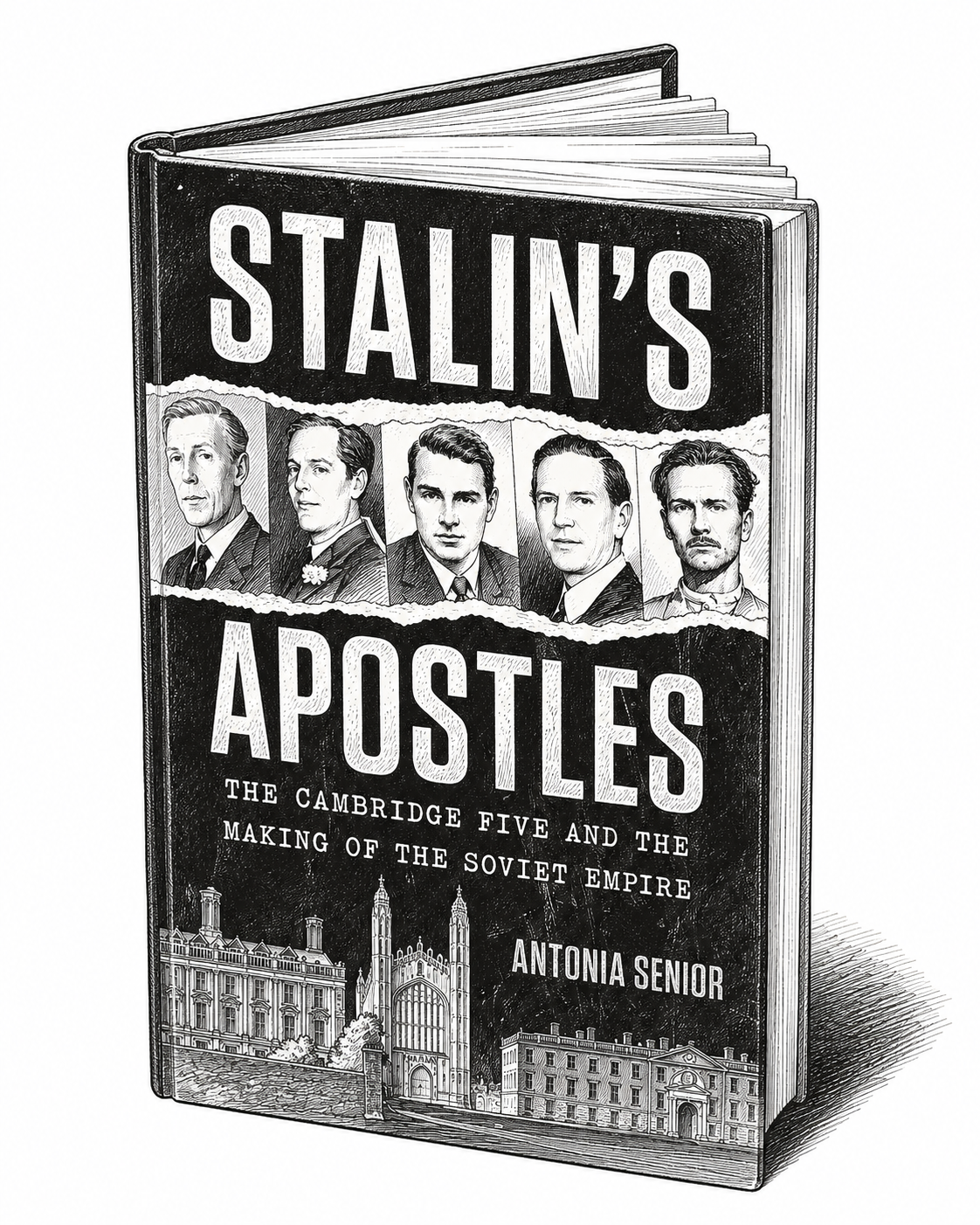
Other covert operatives may prove visible but with unassailable pedigrees. Such privilege comes with its own Achilles heel, however, as it did with several members of an elite university club, the Apostles. Britain's most notorious spies for the Soviet Union, the Cambridge Five, thought of themselves as exceptional and even impervious to being outed. How could such an elite group of young men ever be suspected? But now their disturbing tale of treachery and hubris is being retold by journalist and podcaster Antonia Senior.

A former student of Cambridge historian and British intelligence expert Christopher Andrew, Senior is certainly not the first to tackle this embarrassing and controversial chapter of British history. There are numerous articles, books, and films on the subject, including a well-received 2014 Ben Macintyre biography on Kim Philby, one of the Five. This was followed by a popular recent television series based on Macintyre's Philby book. In addition to exploring these previous works as well as the spies’ own commentaries, Senior’s investigation took her to both American and British National Archives to examine newly released material and similar repositories in Poland, Lithuania, and Albania.

Stalin's Apostles: The Cambridge Five and the Making of the Soviet Empire, which was released this spring, examines what could be called “the great betrayal,” the brutal deception perpetrated by a coterie of “upper-class men, disillusioned with their country, who turned on it, but were protected by their upper-class sheen.” With evident disdain, Senior argues “no one would believe that chaps like Donald Maclean, Kim Philby, Anthony Blunt, Guy Burgess, and John Cairncross could be secret commie spies” intent on doing the nation harm. Regrettably, once suspicions became “impossible to ignore, ranks closed, and they were protected by the establishment.”

Senior’s illuminating saga begins on a Regent’s Park bench in London in June of 1934, with a Soviet talent spotter. Soviet agent Arnold Deutsch had taken a circuitous route to the park that day—three taxis and two Tube transfers—to travel the short one-mile journey from his apartment. The convoluted journey was necessary for there were "terrible dangers" involved in his dark mission. A University of Vienna graduate armed with a Ph.D. and considerable Bolshevik fervor, Deutsch was a Comintern operative dedicated to spreading communism throughout the world. Assigned as a talent scout and sent to England, he was tasked with recruiting "ardent communists among the clever young men connected to Britain’s best universities."

Meeting him that day was Harold Adrian Russell Philby, the son of an overseas civilian administrator who had been prepared to follow his father “to Westminster and on to Cambridge, and then the Civil Service, where Englishmen learned to run an empire.” Harold, better known as Kim, had other intentions.

“Ascetic” in manner and “mediocre” in the classroom, Kim Philby moved from history to economics in academic interest as his socialist leanings “hardened” into communism. Like many at the time, he was caught up in “the long shadow of World War I, the rise of Hitler,” …and “the wave of Marxist fervor that engulfed Cambridge in the wake of the Great Depression.” At their initial park bench meeting, Deutsch regaled the young college student with the wisdom of Karl Marx, capitalism’s many failures, and Kim’s potential role in establishing a new world order.

Years later, Philby recalled his impressions of that first meeting. “I was being offered a very interesting future, a very interesting life. I had a life goal, and I was being offered the means to reach that goal. My future looked romantic.” 

The two men would meet in various London parks in coming years, share information, discuss politics, and ponder in which government departments Philby should seek employment. Philby’s “greatest talents, lying and camouflage,” according to Senior, were still in the developmental stage, but his potential was clear. And he had already agreed to supply names of fellow students—"young men filled with revolutionary fire"—for communist recruitment.

In short order, “legal” Soviet operatives with embassy positions, and “illegals” like Deutsch, Theodore Maly, Ignaty Reif, and Alexander Orlov would comb such lists in search of British recruits. Once snared, they were taught how to pilfer and photograph documents, contact handlers, evade watchers, and travel in evasive zigzags. Although their grasp of (and faithfulness to) the trade varied, there was an air of excitement and a life’s mission “that felt vivid, rapturous, and hopeful.”

Soviet intelligence gathering operations proved incredibly successful. Although backward economically and industrially compared to other Western nations such as the United Kingdom, Germany, and the United States, Stalin’s Russia had developed the best espionage apparatus in the world. Soviet agents carried out their assignments with remarkable precision. The Cambridge caper would prove some of their best work. After Philby came Donald Maclean, a tall, serious, modern languages student; Burgess, a handsome but scruffy history major who was openly gay; Anthony Blunt, the son of a devout Anglican and lover of art; and John Cairncross, a clever young man who arrived at Cambridge with degrees from Glasgow and the Sorbonne but still felt a need to prove himself.

As the months and years passed, the Five insinuated themselves in increasingly sensitive and important positions in government and the private sector. Whatever intelligence of value they discovered was passed on to their handlers. One might think Stalin’s cruel show trials in the late thirties of former leading lights of Bolshevism such as Gregory Zinoviev, Lev Kamenev, and Nikolai Bukharin would have shocked and disillusioned Philby and his Apostle brethren, but they did not. "The young idealists dismissed criticism of the show trials as rightist propaganda," Senior argues. Rather than quit the increasingly bloody and dubious cause, "they doubled down."

And at the most propitious time, it turns out. War was at hand, and would prove all-consuming. British intelligence “wanted clever men…It looked toward academia and the law. Personal recommendations and connections were seen as a good thing.” The Cambridge imprimatur was the gold standard in such a troubled time. The “chapocracy method of recruitment,” as Senior labels it, “meant that all the secret branches of government were riddled with men of dubious sympathy.”

Philby rose to the highest ranks of British security and would have access to key intelligence in both London and Washington, D.C. Maclean received a position at the Foreign Office; Blunt became comfortably situated at MI5; Cairncross entered the Foreign Office, later served in the Cabinet Office as private secretary to Lord Hankey, and then gained access to crucial material at Bletchley Park, the heart of Britain’s wartime codebreaking effort; and Burgess worked with a host of representatives from various British agencies while working at the British Broadcasting Corporation (BBC). The reach and depth of their intelligence gathering operation was astounding.

Maclean’s access to foreign embassy traffic allowed him to see high-level telegrams from around the world; Blunt shared secret information about Operation Overlord, the Allied invasion of France. This is how Stalin learned critical information about the forthcoming Potsdam conference and the Allies' tepid support for postwar freedom in Poland and Eastern Europe. Smaller, but critical Allied military and political missions were made known to Stalin, resulting in hundreds of lives lost and brave freedom-fighters killed or languishing in Siberian penal camps. As Senior puts it, “There was barely a secret, barely a decision made, that Stalin did not know about, thanks to his Cambridge spies and his networks in the United States.”

Some of the most interesting and befuddling sections of Senior’s work come at the end when members of the Five flee to Moscow and escape justice. Philby’s escape in early 1963, for example, confirms British security as a Keystone Cops–like operation years after Maclean and Burgess had fled in similar fashion. Suspicions had arisen, but the implications of their guilt proved “too huge, too damaging, too unbearable to contemplate.” One image-conscious government operative flabbergasted by Philby’s treachery actually suggested, “If we want to avoid embarrassment, the best course would be to let him slip away.”

Authorities would claim they lacked sufficient evidence to arrest and prosecute ring members. Such unenthusiastic pursuit allowed some to decamp, while others remained free and prominent. Blunt stayed in Britain, retained his knighthood until his public exposure in 1979, and—despite his 1964 confession—continued for years in eminent art-world and royal-advisory roles. The affair was forced into public view by journalists and then formally confirmed by Margaret Thatcher in Parliament. Amazingly, he was never prosecuted.

After recounting the many examples of infamy, lost lives, and Soviet expansion, Senior naturally asks, “How could the British be so blind, so stupidly lax?” Her contempt for Britain’s underwhelming hunt and prosecution of Soviet spies is obvious, but she may have missed an opportunity to strengthen her case by contrasting it with the aggressive response of the United Kingdom’s allies. The United States, for example, adopted a far more strident approach in pursuing traitors during the early years of the Cold War.

Granted, there were proper and well-educated American informants working in cahoots with Soviet intelligence. Alger Hiss, for example, with degrees from Johns Hopkins and Harvard Law managed to occupy positions of influence in government, but he was eventually outed. As with the Cambridge Five, many members of the American upper crust were incredulous and came to his defense, including Secretary of State Dean Acheson. But the evidence was overwhelming, and Hiss was convicted of perjury, sentenced to five years in prison, and served forty-four months.

An even better example may be those Americans caught up in atomic-bomb espionage. Harry Gold, who J. Edgar Hoover claimed was the target of “the greatest manhunt in history,” and a centerpiece of “the crime of the century” was tried, convicted, and given a 30-year sentence. (He would spend approximately 16 years behind bars.) Morton Sobell was convicted and served eighteen years of a thirty-year sentence; David Greenglass pleaded guilty, received a fifteen-year sentence, and served ten years. Ethel and Julius Rosenberg were found guilty of conspiracy to commit espionage and executed.

The British, meanwhile, stayed the course, apparently comfortable with a minimalist approach regarding traitors. Klaus Fuchs, the German-born, British physicist at Los Alamos who supplied the Soviets with the most valuable information about the construction of an atomic bomb, was dealt with rather gently by the English court system once he confessed. Given a rather modest (by American standards) fourteen-year sentence, he was set free after nine years. One suspects his treatment would have been even gentler had he been born in Harrogate and educated at Cambridge rather than in Rüsselsheim and Leipzig.

Some espionage scholars may argue that there is little new in Senior’s account, that more explanation was needed to distinguish the GRU (Soviet Military Intelligence) from the NKVD (the Soviet Union's Secret Police), and that the book is less captivating for a general audience than Macintyre’s. Macintyre’s book focused primarily on Philby; what about the four others? They were the Cambridge Five after all, and they all had interesting lives. Burgess betrayed his closest friend and even requested the Soviets kill him; Maclean took so much valuable material from the Foreign Office “his handlers had to beg him to slow down”; Anthony Blunt had a warm relationship with Queen Elizabeth, and the spies’ marital and sexual escapades are a story themselves.

Senior’s tale of “the most extraordinary espionage ring in history” is a powerful one and continues to leave us all asking: “Why would these men, these gilded, charming men, blessed with brains, beauty, and opportunities, choose to betray their country?” And Senior provides some compelling answers. More documents may yet emerge from archives in London, Washington, and Moscow, but what we already know is damning enough: The magnitude of the crime—and the British government’s uninspired response to it—speaks for itself.

Allen M. Hornblum is a former professor at Temple University and a former chief of staff at the Philadelphia Sheriff's Office. He has authored books on a range of subjects including organized crime, Soviet espionage, sports, and medical ethics. His book, The Invisible Harry Gold: The Man Who Gave the Soviets the Atom Bomb, was published by Yale University Press in 2010.
