
From the archive
Mon Laferte and the Power of Toplessness

“Apparently, there is a significant difference between a woman who decides to show her breasts in a glittery outfit or a see-through dress—and someone who does it in the name of a social cause.”
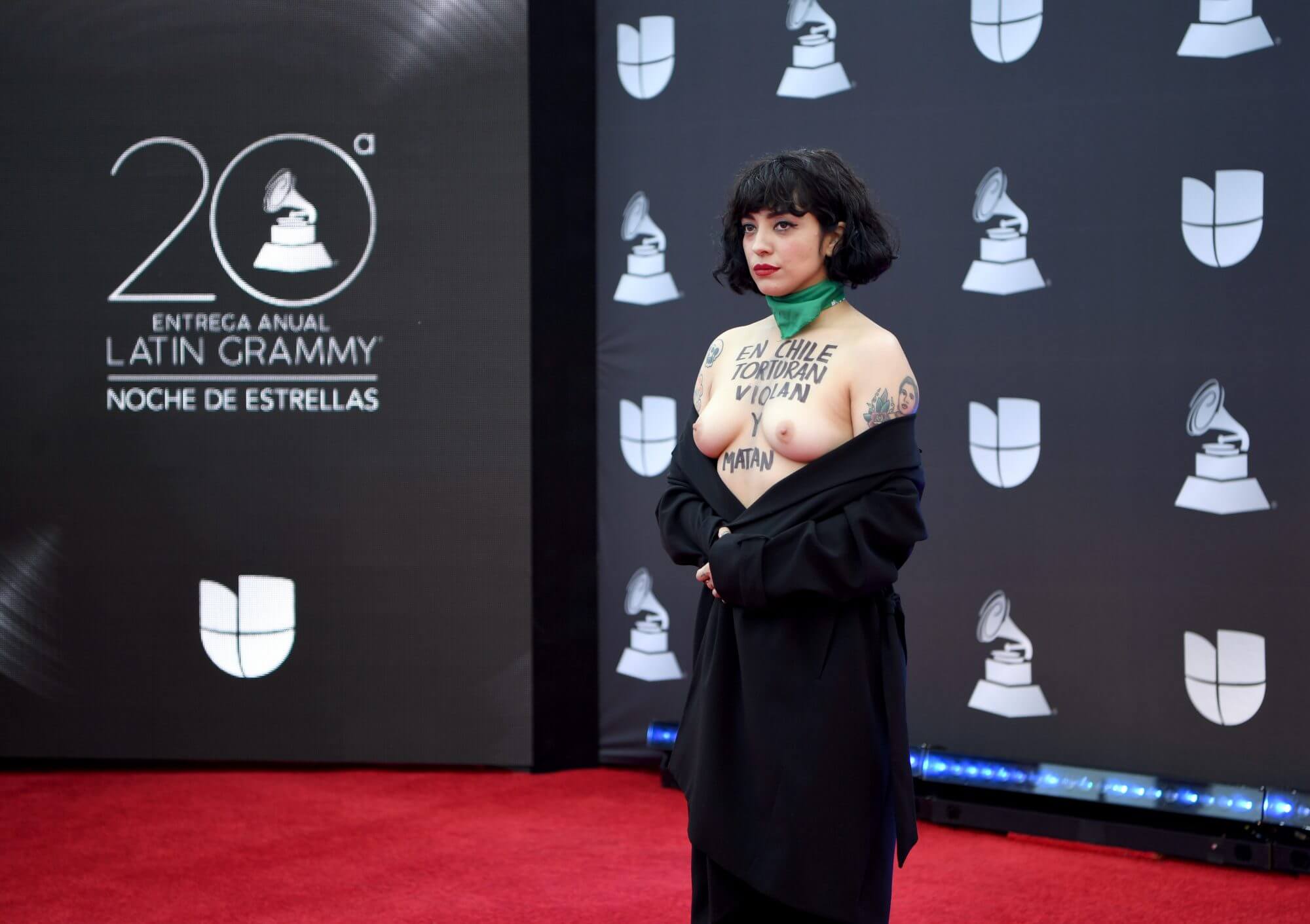
“Apparently, there is a significant difference between a woman who decides to show her breasts in a glittery outfit or a see-through dress—and someone who does it in the name of a social cause.”
During the latest Latin Grammy Awards on November 14th, Chilean singer and songwriter, Mon Laferte, wrote on her chest, “In Chile, they torture, rape, and kill” (En Chile torturan, violan y matan) to draw attention to the current uprisings in her home country. While walking down the red carpet, Mon faced dozens of photographers and journalists and exposed her breasts. Immediately photographs of her naked torso were uploaded online, and, in many cases, the images were accompanied by criticisms about her manner of protest and references to her “imperfect” body. Unsurprisingly, once again people started questioning whether revealing a woman’s body was a legitimate way to express a political message. And, on all sides of the debate, there also surfaced an undertone of surprise: at how much stir some words written on a pair of breasts could cause. Her November 14th red carpet moment also took place around the same time as the release of her reggaeton protest song “Plata Ta Tá,” created with the Puerto Rican musician Guaynaa.
Women’s bodies have long been overly-sexualized: “breasts, boobs, bosoms, titties, chichis“ have served as an object of pleasure for men—as the core of their fantasies, their wet dreams, their idealization of women. In an environment still influenced by that ethos, a woman’s naked torso, to many, can only mean one thing: sex. So what happens when women take control of their bodies and use them for other purposes? Some women feel empowered; other women might, in fairness, prefer to avoid using their bodies for social statements. But it is often men who find themselves becoming particularly critical of women who use their bodies in this way; this is not the context in which most men are used to seeing breasts.
Apparently, there is a significant difference between a woman who decides to show her breasts in a glittery outfit or a see-through dress—and someone who does it in the name of a social cause. Why are we, as a society, so alarmed when we see female bodies exposed for different reasons? There appears to be a big difference between an influencer showing her boobs in the name of fashion and another doing so in the name of a social movement; one is more fit for consumption and idealization, while the other is making an uncomfortable statement. Breasts, for many, are “a-okay” on billboards or in pornography; they are beautiful and sexy. Breasts filled with milk waiting to feed a newborn are ‘disgusting.’ Using breasts as a tool for protest is a taboo, a visual discomfort, and sometimes even constitutes a crime. Men who have covered their torsos in words of resistance such as Residente have not been so intensely criticized; instead, they have been called brave, transcendent, honest, and powerful. But when women do it, criticisms and skepticism about their motives so often follow.
The rest is for members.
All proceeds go toward publishing more writers and poets.
Free for 30 days, then $3 a month
Become a member
This work is preserved in Merion West’s archive of articles and poems published from 2016 through early 2025. Explore the archive