
From the archive
A Jordan Peterson Biographer Missing the Mark

Jim Proser’s new biography on Jordan Peterson portrays him as a Christlike figure plagued by personal demons. Yet the real devil here is in the details.
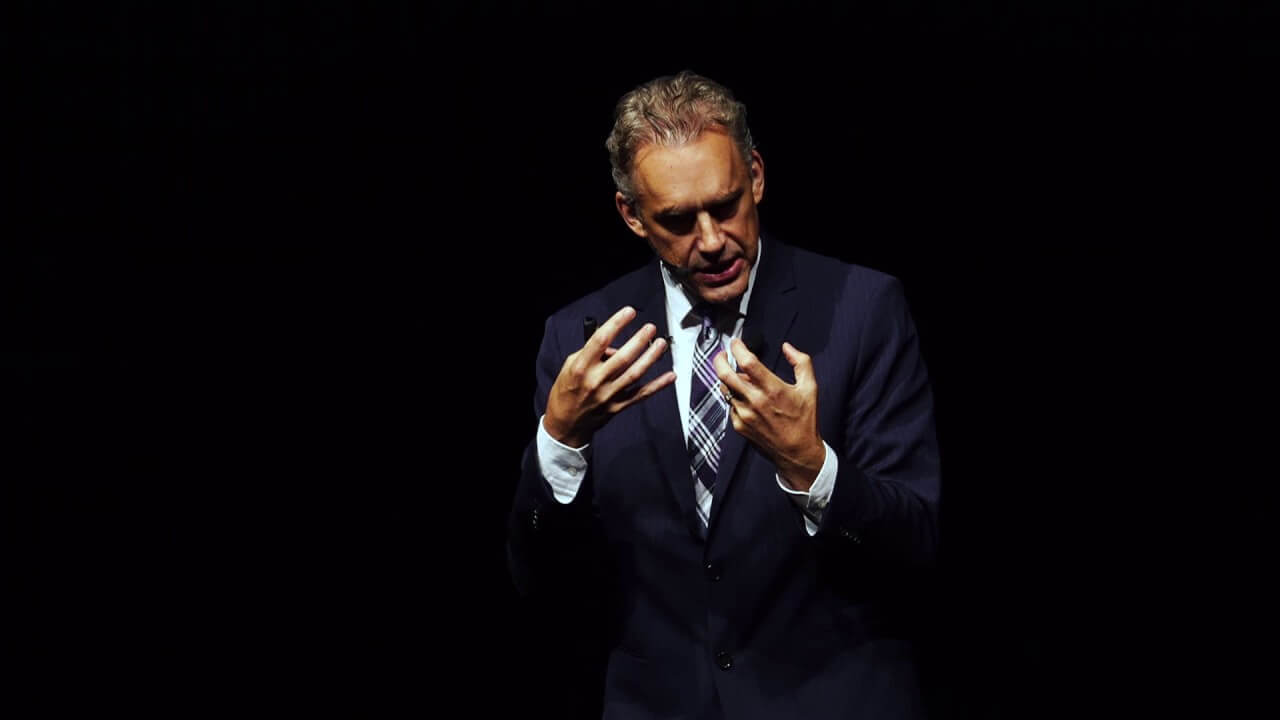
Jim Proser’s new biography on Jordan Peterson portrays him as a Christlike figure plagued by personal demons. Yet the real devil here is in the details.
What does one say about Jim Proser’s new biography of Jordan Peterson, Savage Messiah: How Dr. Jordan Peterson Is Saving Western Civilization? The first thing is that it’s not a biography, at least not in the modern sense of Boswell’s Life of Samuel Johnson—a text that’s extensive leveraging of archival records, eye-witness accounts, and interviews effectively bestowed the genre with a veneer of objectivity that’s defined it ever since. By contrast, what Proser offers us here—as can be inferred from the title—is essentially a Christ allegory: one in which Peterson is portrayed as being the lone individual capable of saving “Judeo-Christian Enlightenment values” from the “vipers” of “postmodern neo-Marxism,” resurgent since the “anti-Western” movement of Occupy Wall Street. And should one dispute Peterson’s candidacy for comparison with Christ on the grounds that the latter was put to death for his sermons whereas the former has become rich off of them, Proser constantly reassures us of the mental anguish Peterson has endured on account of “neo-Marxist aggression,” which at one point, “literally surrounded him, invaded his classroom, threatened his career and the future stability of his family.”
Given the apocalyptic sense of importance Proser assigns to Peterson, many readers may be curious as to just who he is. In 2016, Peterson first attracted widespread notoriety for his publication of a video on YouTube, “Professor Against Political Correctness: Part 1.” The video, which featured Peterson’s voice—imagine Kermit the Frog trying to evince the air of a truth-telling patriarch—dubbed over a handful of black-and-white PowerPoint slides, was austere. It was also factually dubious: in it, for instance, Peterson—a Canadian, who currently teaches at the University of Toronto—confuses Canadian jurisdictions, waxing on about the threat posed to academic freedom by the Canadian government’s effort to legislatively protect gender-nonconforming individuals seemingly unaware that his own vocation falls under provincial mandate. Naturally, few noticed, and Peterson was able to parlay his burgeoning star as a professor capable of legitimating the intellectual pretensions of the alt-right into a best-selling book two years later, 12 Rules for Life: An Antidote to Chaos. 12 Rules for Life, which builds on Peterson’s efforts to map Jungian archetypes onto neuroscience in his earlier book Maps of Meaning, is—at bottom—a pop psychology book sprinkled with a few inchoate philosophy references (Peterson succeeds in misreading numerous thinkers throughout the book, including Heidegger and Derrida). However, by this point, the question of Peterson’s academic bona fides was largely a moot one. His nonstop polemicizing against the left—whose ideology he coined the neologism “postmodern neo-Marxism” to describe, sloppily compounding differences a more rigorous thinker would’ve bothered to delineate—supported by his nonstop lecture tours, had already resonated with a mass audience. 12 Rules was just the tour souvenir.
That Peterson’s elevation to fame occurred relatively recently poses a distinct problem to Proser as a biographer. Jordan Peterson is 57 years old—hardly an upstart. Yet as he was not a public figure prior to his fiftieth year, writing a genuinely comprehensive biography would’ve required undertaking substantial research to supplement Peterson’s own accounts (part of the appeal of Peterson’s books and lectures lies in the way he frequently recounts stories supplied from personal experience). But whether out of laziness (or whether out of a desire not to impinge upon the soupcon of prophecy Peterson has built up around himself), Proser instead elects to use the book’s first half to furnish his readers with an assemblage of chronologically organized anecdotes about Peterson’s life derived from none other than Peterson (and virtually all readily available elsewhere). The best thing that can be said about this part of the book is that—in so far as the events in question occurred prior to his transformation into the public intellectual par excellence of the Right—it’s impossible to say categorically that they’re wrong (though one does get the sense that taking them at face value would be a bit like seeing a long cut of Purple Rain and mistaking it for authentic biography). The worst thing that can be said is that Proser here does the exact opposite of what a biographer should do, inflating Peterson’s personal mythology rather than slicing through it.
The rest is for members.
All proceeds go toward publishing more writers and poets.
Free for 30 days, then $3 a month
Become a member
This work is preserved in Merion West’s archive of articles and poems published from 2016 through early 2025. Explore the archive