
From the archive
The Clash and the Quest
In this essay, Alexander Zubatov traces how the stories that fill the boundless canvas of Western canon are, in essence, reflections of two contrasting Homeric archetypes. Venturing beyond the literary, the motifs offer the frames through which one can interpret existence itself.
When first young Maro in his boundless mind
A work t’ outlast immortal Rome design’d,
Perhaps he seem’d above the critic’s law,
And but from Nature’s fountains scorn’d to draw:
But when t’ examine ev’ry part he came,
Nature and Homer were, he found, the same.
-Alexander Pope, “An Essay on Criticism”
The Iliad and The Odyssey are not only the alpha and the beta of our literary alphabet; they are its alpha and omega. They are its poles and touchstones. They define its gamut. They constitute, as well, the two most fundamental narrative tropes through which we structure human experience, both personal and historical.
The Iliad begins with anger (its first word); it is, thus, a dramatization of conflict, a great conflagration and its resolution. It starts after the conflict’s origins and ends before its terminus, but such is inevitably the way with dramas of this sort. Even when the illusions of the conflict’s primeval inception and total resolution are more actively cultivated, as in The Lord of the Rings trilogy, the question of what came before and what will come after are inevitable, and if the author can convince us that it does not matter, that death or the happily-ever-after truly ends all, he has fulfilled our expectations.
Within such narratives, the central conflict, the “Clash,” is the centerpiece around which all preliminary and subsidiary conflicts are organized. It is the engine that sets the narrative in motion upon the dramatic arc it must traverse in order to arrive at its ultimate destination, which is either a success or a failure of some significant sort (to quote Céline, “There’s an ending to everything. It’s not always death, it’s often something else and possibly worse, especially when there are children”). Chekhov observed that all endings are banal, with stories concluding either in the protagonist’s marriage or else in his death. In a similar vein, Slavoj Žižek has noticed that Hollywood films almost invariably end with the literal or figurative reconciliation of the family in one or another form. If these are overstatements, they do not overshoot the mark by much, at least not as far as conflict literature is concerned.
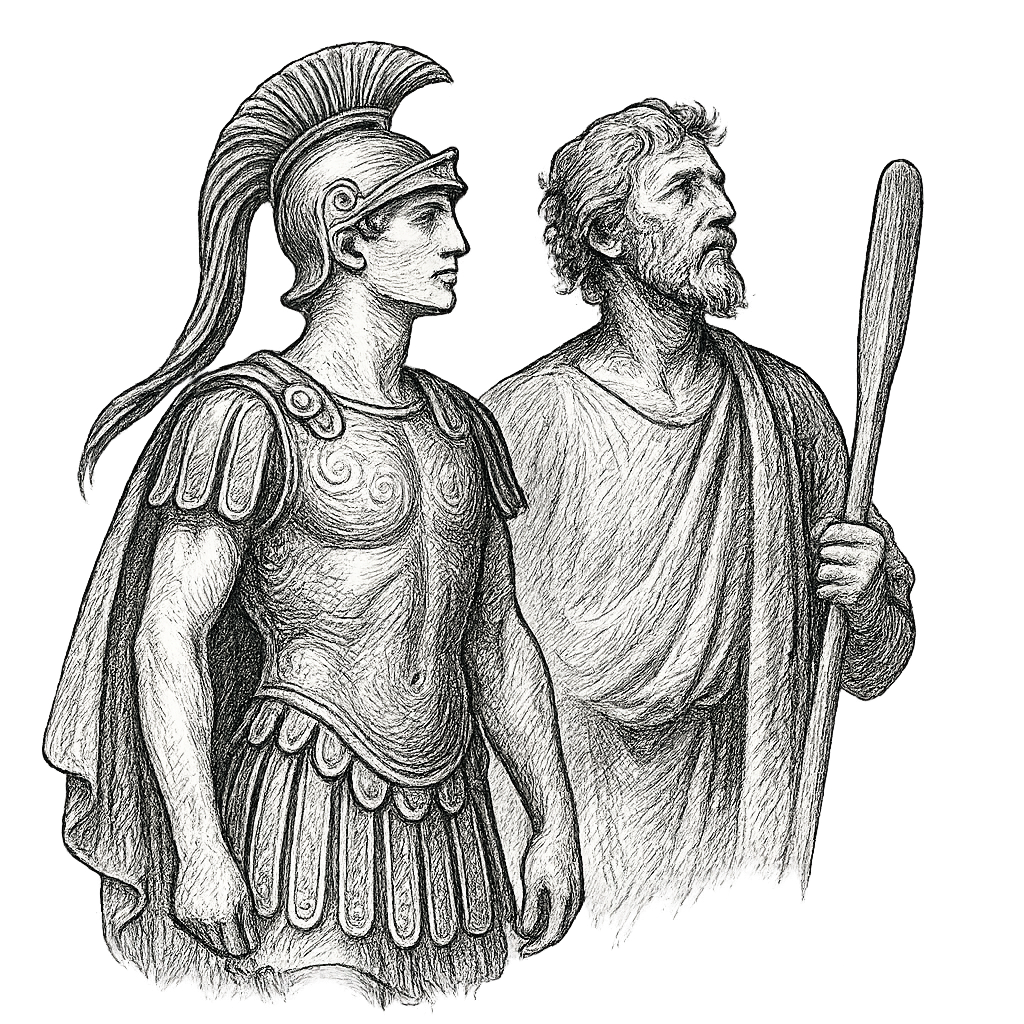
There are many examples of this type of narrative. From Paradise Lost to Tess of the D’Urbervilles; Wagner’s Ring and most opera libretti; the vast majority of fairy tales and of plays, whether those of the Greek tragedians or Shakespeare or Racine; and nearly all thrillers; mysteries; and other genre fiction, whether horror, fantasy, sci-fi or romance, kids lit, chick lit, lit lite; and the many popular films which bring such and similar tales-in-a-box to the silver screen.
The rest is for members.
All proceeds go toward publishing more writers and poets.
Free for 30 days, then $3 a month
Become a member