
From the archive
Review: “Crassus: The First Tycoon” by Peter Stothard
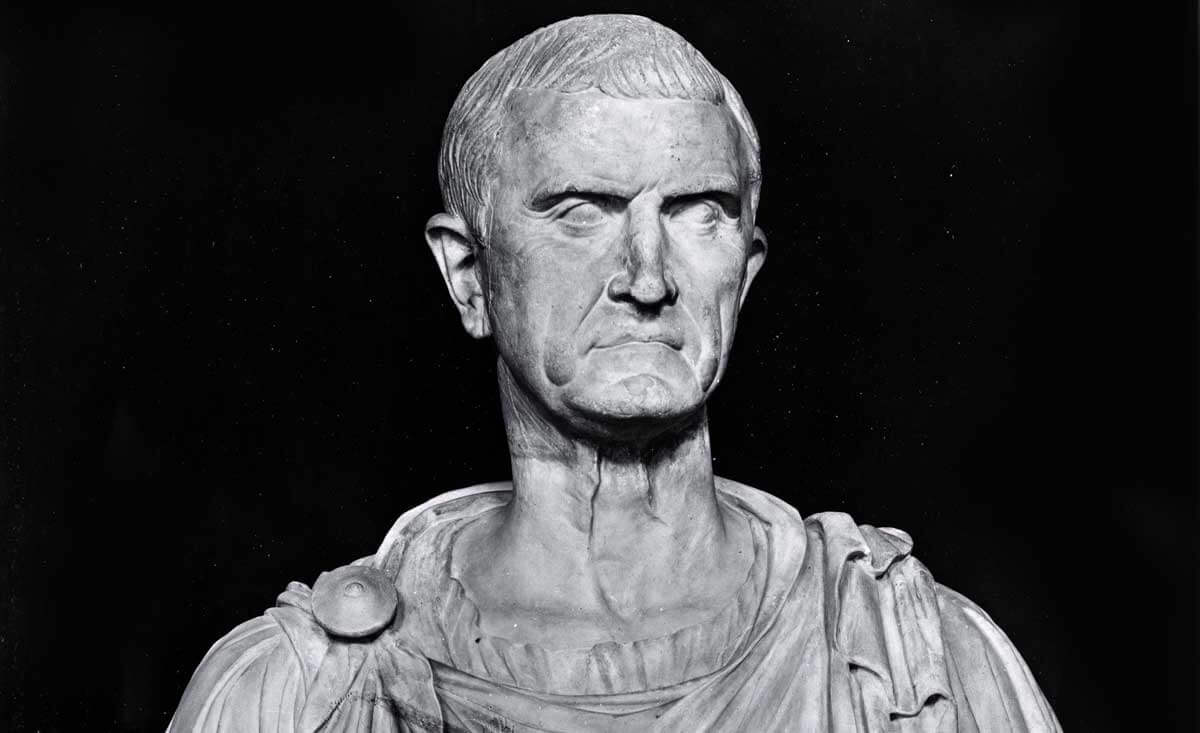
“Now, Peter Stothard has given us the final decades of the republic through the eyes of Crassus—Rome’s wealthiest man and former consul who famously embarked on a vainglorious and ultimately failed conquest of Parthia that culminated in his embarrassing death.”

“Now, Peter Stothard has given us the final decades of the republic through the eyes of Crassus—Rome’s wealthiest man and former consul who famously embarked on a vainglorious and ultimately failed conquest of Parthia that culminated in his embarrassing death.”
“The first tycoon of ancient Rome was also its most famous loser. If Marcus Licinius Crassus had died in 54 BCE he might have quietly entered history as Rome’s richest man, its first modern financier and political fixer…His modern face would have been from 1960, Laurence Olivier in Stanley Kubrick’s Spartacus.” If people still know the name Marcus Licinius Crassus, it is, indeed, from Olivier’s portrayal of the Roman tycoon and general from Kubrick’s epic film. Perhaps a few others have read his name in passing from books on the fall of the Roman republic. But few have any intimate knowledge of a man who was once the rival of Julius Caesar and Pompey during the nadir of the republic, a name that all of Rome knew well in the republic’s final decades.
A millennium and a half after the life of Crassus, Petrarch remarked that history was but the praise of Rome. While praise of Rome has fallen on hard times as of late, Rome still sells well and is open for business even at the places that also want to extinguish the light and flame of the eternal city perched on those seven Italian hills. There has been no shortage of recent histories of Rome, the end of the republic, and the birth of the empire under Augustus. What has proliferated in the past two decades of these never-ending Roman histories and biographies is the story told from new perspectives. This we can, and should, be thankful for.
We are all familiar with the fall of the republic from the eyes of the immortal names of Caesar, Augustus, Antony, and Cleopatra. Now, Peter Stothard has given us the final decades of the republic through the eyes of Crassus—Rome’s wealthiest man and former consul who famously embarked on a vainglorious and ultimately failed conquest of Parthia that culminated in his embarrassing death.
The fact that a biography of Crassus did not exist for popular readership has been corrected by Stothard. We wonder why it was not done sooner. Crassus’s life coincides with all of the great luminaries, once formerly famous, still famous: Marius, Cinna, Sulla, Julius Caesar, Cicero, Pompey, and Spartacus. During the tumultuous years as the republic failed and the march to dictatorship and empire commenced, Crassus found himself in the thick of the maelstrom and emerged as one of its great victors before his own greed—per Plutarch—eventually betrayed and killed him.
The rest is for members.
All proceeds go toward publishing more writers and poets.
Free for 30 days, then $3 a month
Become a member
This work is preserved in Merion West’s archive of articles and poems published from 2016 through early 2025. Explore the archive