
Constitutional Distortion and America's National Debt

As America’s debt nears $39 trillion, policymakers debate spending while ignoring a deeper question: Is much of modern federal spending constitutionally authorized? William J. Watkins, Jr. argues expansive readings of the General Welfare and Commerce Clauses helped create today’s crisis.

The United States is drowning in a sea of red ink. The national debt currently stands at just shy of $39 trillion. To retire the debt, every American citizen would have to kick in over $115 thousand. Considering that fewer than half of American adults have enough emergency savings to cover three months of expenses, a national assessment would be futile.

Some dismiss high debt numbers by claiming we just owe it to ourselves, which means there is no need to worry. That is not true. Foreign countries hold nearly twenty-three percent of American debt (Japan, the United Kingdom, and China account for the top three).
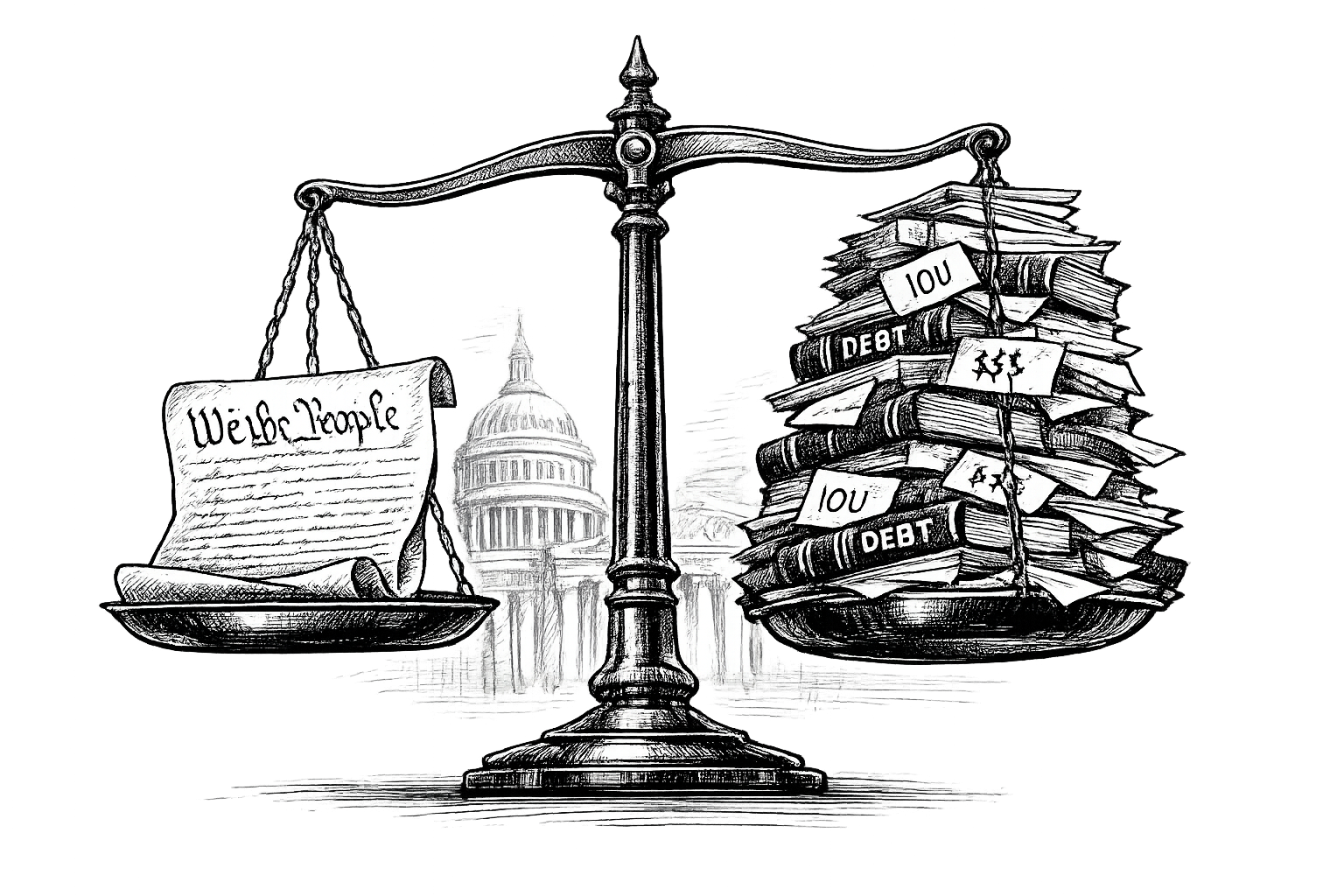
So how did we arrive in the present situation?  The answer is clear: by ignoring the Constitution’s limits on the federal government’s powers. Social Security, healthcare, and welfare payments account for six out of every ten dollars of federal spending. Congress, however, has no delegated power authorizing it to spend on these matters. Rather, it has garnered additional power through inventive and dishonest interpretations of our fundamental law.  

The current situation has been a long time coming.

The Anti-Federalists at the time of the Constitutional Convention worried that Congress’s power to tax and spend for the “general welfare” meant unlimited power. Virginia’s Richard Henry Lee, for example, feared that those two words permitted Congress “[t]o judge of what may be for the general welfare” and to pass laws “with every possible object of human legislation.”

The Federalists, in turn, scoffed at this interpretation. Such an objection might have weight, James Madison acknowledged, but for the careful enumeration of powers that followed the introductory language referring to the general welfare. Madison continued:

"For what purpose could the enumeration of particular powers be inserted, if these and all others were meant to be included in the preceding general power? Nothing is more natural nor common than first to use a general phrase, and then to explain and qualify it by a recital of particulars."

In other words, Madison and the Federalists assured Americans that Congress could not legislate or spend unless it pointed to a specific enumerated power following the introductory language in Article I, Section 8. Indeed, the Constitution was sold to the American people as a system that would allow the states to address myriad domestic matters while the federal government focused primarily on external concerns such as foreign trade and foreign policy.  

The Supreme Court, at the urging of President Franklin Roosevelt and other New Dealers, rejected the Madisonian interpretation when it decided United States v. Butler in 1936. Believing that it understood our fundamental law better than the Framers did, the Court held that the spending of money “is not limited by the direct grants of legislative power found in the Constitution.” So long as Congress asserts a matter is conducive to the national welfare, it may act.  So much for the Framers' design of a limited government.  

Another tool used to create and expand government programs is the Commerce Clause. Pursuant to this enumerated power, Congress may “regulate Commerce with foreign Nations, and among the several States, and with the Indian tribes.” When the Constitution was drafted, commerce was understood, as explained in Samuel Johnson’s Dictionary of the English Language (3d ed., 1765), as “intercourse, exchange of one thing for another, interchange of anything; trade; traffick.”

The purpose of the Commerce Clause was to establish a free-trade zone within the United States by removing internal trade barriers—to promote the unhindered traffic and exchange of manufactured items and foodstuffs. The clause also allowed the federal government to regulate foreign trade and to retaliate if nations restricted the entry of American products.  

In the New Deal era (again at the behest of President Roosevelt and his so-called brain trust), the Court redefined interstate commerce as “economic activity.” If an activity substantially affects (or potentially could affect) the national market, then Congress may regulate and spend money on the activity via the Commerce Clause. Because almost any activity conceivably could have some effect on the economy, Congress has used the Commerce Clause to pass laws dealing with everything from crime to civil rights. The Commerce Clause is also the basis for the Administrative State which governs labor, environmental, and economic policies touching upon a unified national market.

If Americans want to escape our spiraling debt, the Constitution is the proper starting point. Popular and expensive federal programs such as Social Security and Medicare have no basis in the federal Constitution.  By ignoring the confines of our fundamental law, the federal government is drowning citizens in a sea of debt. We can address our spending problems now or wait for our foreign creditors to cash in their chips. Neither approach will be painless, but the latter will likely end our century of world influence and prosperity.  

William J. Watkins, Jr. is a Research Fellow at the Independent Institute and author of The Independent Guide to the Constitution and Crossroads for Liberty: Recovering the Anti-Federalist Values of America’s First Constitution. He has served as a prosecutor and defense lawyer and has practiced in various state and federal courts.
