
The Movement James Burnham Began

David Byrne, the author of a recent biography of the mid-century conservative intellectual James Burnham, traces the thinker's influence on Goldwater, on Reagan, on Musk.

James Burnham, who lived from 1905 to 1987, began his intellectual career as a disciple of Leon Trotsky and ended it as William F. Buckley’s mentor at National Review. He influenced figures from George Orwell to President Ronald Reagan, from C. Wright Mills to Senator Barry Goldwater. More recently, Burnham has been called an embryonic neoconservative and a proto-Trumpist. Both assessments are correct.
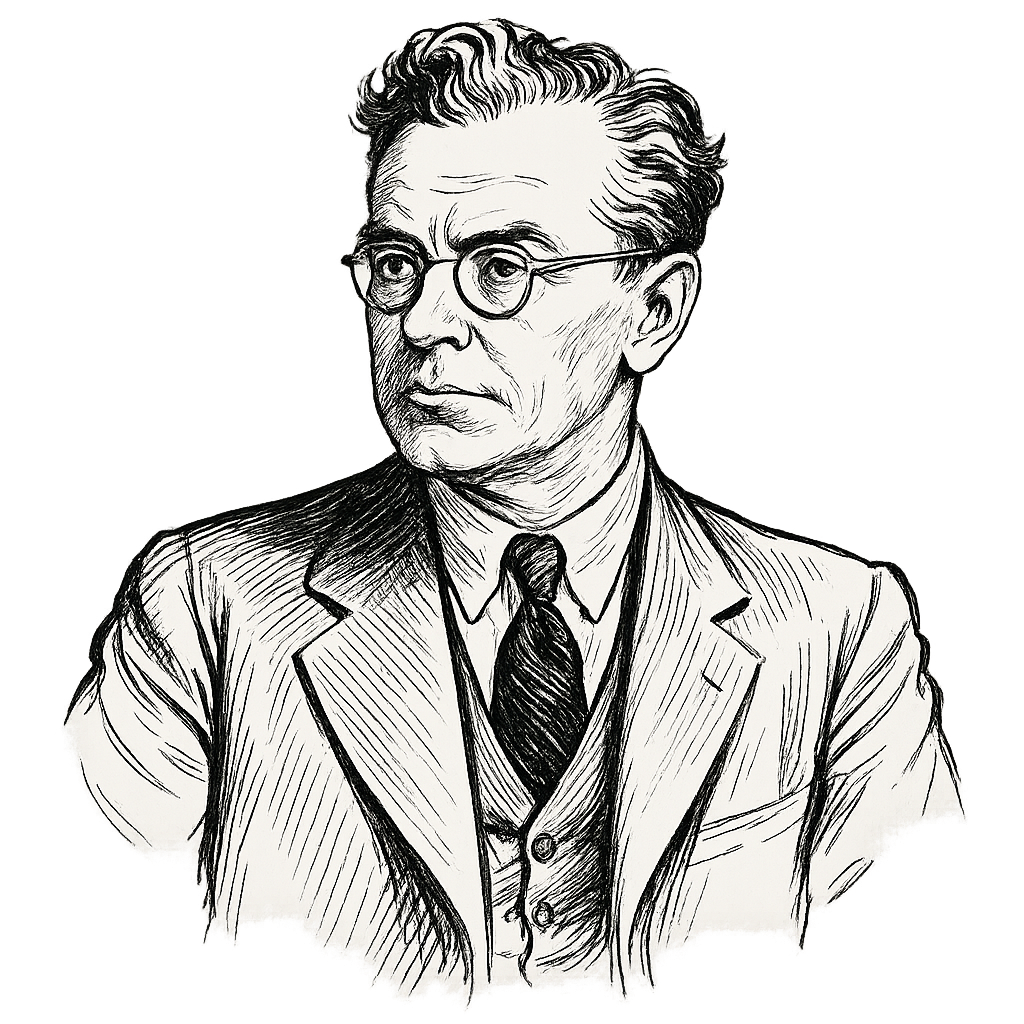
Burnham’s intellectual odyssey began during the Great Depression, when he became a trusted follower of Leon Trotsky. In dozens of articles for socialist newspapers, he demanded the overthrow of the "imperialist" government of President Franklin D. Roosevelt, insisting that it merely advanced the interests of the economic elite. Burnham believed justice could only be brought to America through a revolution that displaced its ruling class.

Burnham began questioning Marxism in the late 1930s in the wake of Joseph Stalin’s purges. The Nazi-Soviet Pact and the Soviet invasion of Poland further eroded his faith. He pivoted by challenging Trotsky’s assumption that the Soviet Union was a state for the working class and openly disavowed Marxist concepts like the dialectic, the unity of opposites, and the inevitable victory of the proletariat. Stalin was not the problem in the Soviet Union, he wrote. Marxism was. 

Trotsky fired back. Consistent with ideas he had presented in his classic 1937 work The Revolution Betrayed, Trotsky refused to fault Marxism. The revolutionary declared that Stalin and his bureaucratic clique had perverted the revolution. Not persuaded, Burnham left the Marxist movement in May of 1940.

Burnham then penned two critical political books, The Managerial Revolution in 1941 and The Machiavellians in 1943. In the former, he predicted that the future would belong to bland corporate managers and bureaucrats. The latter argued that the ruling classes only cared about exercising power; the sly rulers deceptively used words to manipulate the masses. These books helped inspire George Orwell’s 1984, a story about how vapid party members use words to rule over society. Burnham’s works also remain classics among American paleoconservatives who believe bureaucrats and administrators have gained too much power and are the new enemies of democracy. 

After World War II, Burnham turned his attention to foreign affairs and became one of America’s foremost anticommunists. In his 1947 book The Struggle for the World, he warned against Soviet expansion and insisted that the United States must use power—possibly even violence—to confront the Soviet behemoth because a defensive strategy could never win. Burnham sought to liberate the peoples of Eastern Europe from the Soviet yoke. The new hardliner demanded an American empire, through which the United States exerted its power and influence around the world against communism. 

This crusading spirit against Soviet power abroad would shape Burnham's views at home. He wanted to outlaw the Communist Party, and he refused to condemn Senator Joseph McCarthy or his congressional investigations. As McCarthyism became one of the central political issues of the age, Burnham called himself “anti-anti-McCarthyite.”  His neutrality toward McCarthy ended friendships and limited writing opportunities with left-wing journals. A colleague said that he had committed professional suicide. 

Yet Burnham's uncompromising stance against communism would soon find a more receptive audience.

Fortunately for Burnham, just as he was burning bridges with the left, William F. Buckley was eager to start a new conservative magazine, one with a strong anti-communist and free-market slant. Burnham agreed to become a senior editor at National Review, and, in time, he became its second most important figure for the next 23 years. He would never have to criticize McCarthy there.

Burnham’s primary task was to analyze foreign affairs, which for him meant emphasizing the Soviet threat. He wanted to raise consciousness about the raging power struggle—one he thought the Soviets were waging more successfully. Burnham usually portrayed American foreign policymakers as bumbling; he lambasted containment and détente, believing they benefited only the Soviets. He called for the United States to invest heavily in its military because the Soviets could not win an arms race. As the Vietnam War escalated, this Cold Warrior demanded that the United States show strength because disarmament was counterproductive. He believed the United States promoted its national interest by using hard power in Vietnam. Burnham later explained America’s failure by claiming she had not used enough force. 

Burnham has profoundly influenced conservative politicians and policymakers, both domestically and internationally. The ideas presented in The Managerial Revolution and The Machiavellians have contributed to attitudes culminating in efforts by President Trump and Elon Musk to weaken the power of the bureaucratic elite. The last chapter of Senator Goldwater’s The Conscience of a Conservative, titled “The Soviet Menace,” is based on Burnham’s ideas. President Richard Nixon and Secretary of State Henry Kissinger grappled with Burnham’s demands to use more hard power in Vietnam. President Ronald Reagan employed Burnham’s ideas to confront communism and even admitted his debt to Burnham. Justly or not, neoconservatives such as William Kristol have used Burnham’s geopolitical ideas to argue for an activist American foreign policy that aims at liberation. This all testifies to Burnham’s enduring intellectual influence and why we should continue to engage with his ideas, even decades after his death.

David Byrne earned his Ph.D. in intellectual history from Claremont Graduate University. He is the author of James Burnham: An Intellectual Biography, which was published in March.
