
Note from the Publisher: This piece belongs to the Merion West Legacy series, referring to articles and poems published between 2016 and early 2025.
A Soviet Immigrant Reminds Americans What They’ve Forgotten
“This country confers upon people the basic, fundamental dignity—starkly absent in Soviet Russia and in many other places on Earth—of drawing a more-or-less direct line between our life choices and our lives’ outcomes.”
This article is part of the Why America? series exploring the idea of American moral authority through the perspectives of recent immigrants.
In 1979, my parents and maternal grandparents came to New York as refugees from communism from the former Soviet Union, from that ever-overcast northern city where the Neva River meets the Gulf of Finland and the Baltic Sea, memorialized as the miasma-beset protagonist of Andrei Bely’s Petersburg, and which, in our time there, bore the nation’s founder’s holy name.
My parents and grandparents brought with them in tow a few possessions—some clothing, jewelry, photo albums and the like—the four-year-old me, and a grand total of $300, the maximum you were permitted to take with you when you left back in those days. My family was educated. My grandfather was a dentist, my grandmother a teacher. My mother had a degree in British history, while my father was working on his Ph.D. dissertation in psychology. My grandparents, especially, lived a comfortable life, with a spacious apartment in the very center of the city. Why, then, did we flee? Why would my parents and grandparents leave behind everything and everyone they had ever known, their culture and heritage, their apartments and their lifetimes of cherished, accumulated objects for a country where they knew no one, where their degrees and skills would be of little use, where unfamiliar words would be mashed together and left to bound around in what sounded, to the earthy Slavic ear tuned to the patter of plosives and hiss of fricatives, like so many thick, plucked strings echoing out their facile twang?
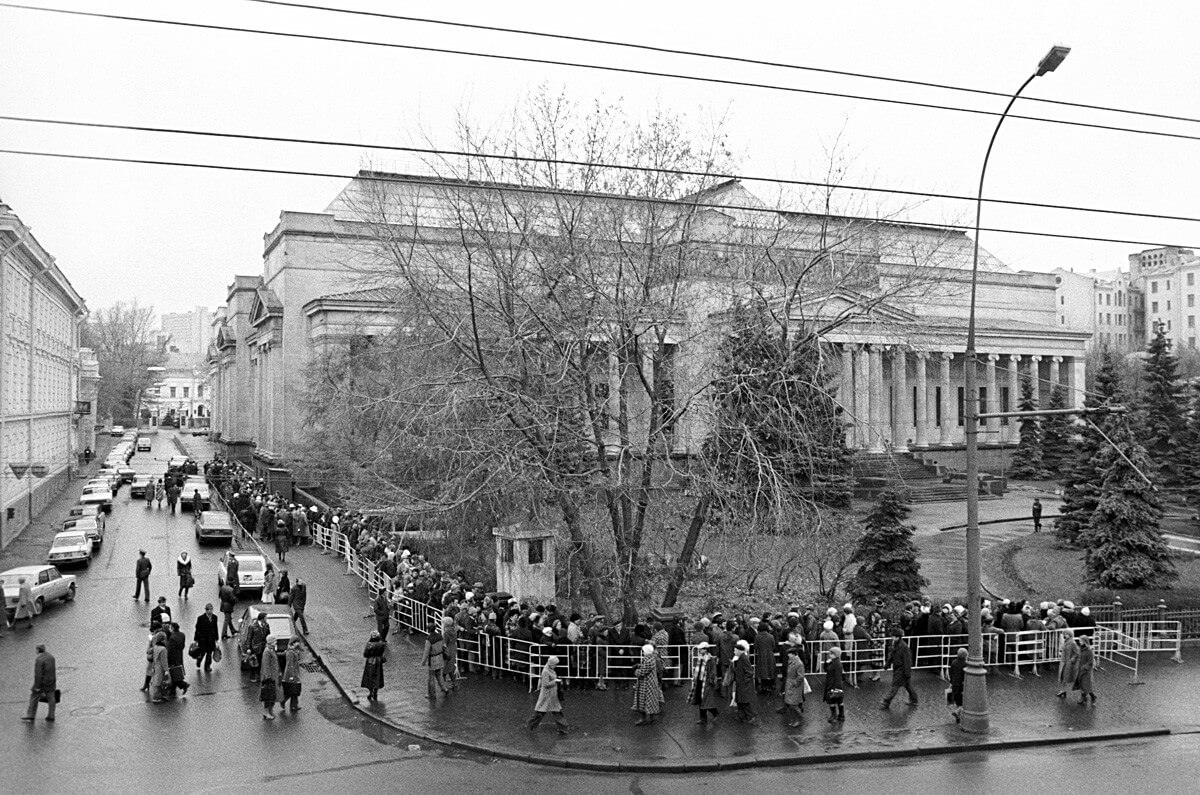
By the late 1970s, already deep into the nation’s dotage in the Brezhnev years, Soviet citizens no longer felt either the thrill, sturm and drang of Lenin’s world-shattering revolution nor the incessant terror of Stalin’s long reign, nor even the new energy infused by Khrushchev’s humanizing reforms. Daily life in Brezhnev’s Soviet Union was a slog but a slog it was possible for most to endure. There were the internationally renowned bread lines, of course, amid many other regular food shortages, and the general chronic resource misallocations that are part of the package when the State’s central planners replace the free market (hence, the infamous mass re-appropriation of old newspapers when toilet paper was not available, as it usually was not), but people were not dying of hunger in the streets. There were the bureaucratic obstacles to be navigated and the arrays of hoops to be jumped through at every turn, but those who endeavored to live a quiet life (and stayed away from direct criticism of the powers-that-be) were largely left alone.
There was the perpetual pursuit of access to all the informal quasi-legal gray market and illegal black market channels that could give you leads on many of the kinds of perks, privileges, and things most of your fellow citizens did not have, and this—with the inevitable petty jealousies it inspired—brought with it constant paranoid fear of would-be denouncers and informants who might squeal on you to the higher-ups. My grandfather, who died earlier this year of natural causes at the ripe old age of 100, was particularly adept at playing this dangerous game. He was known for his always sunny disposition, his unflappable demeanor (I had never once seen the man lose his temper), his extraordinary social skills, and his utter shamelessness in asking for “extras” at every bureau and corner store, as he traded “off hours” dentistry for life’s extra loaves, bottles, and fatty hams.
Education was the way out, the path to a better life. But education could take you only so far.
All of this is to say, again, that life in the former Soviet Union in the 1970s under Brezhnev was unpleasant but not unbearable. And this was especially true in light of where we had come from, the unremitting beat-down that Russian history had inflicted on the nation’s populace: hundreds of years of absolute rule by a succession of inbred autocrats, and centuries, as well, of serfdom. People were tied to and passed with the land they were obligated to work without even the racial distinction between master and slave that conferred a cruel logic upon the American alternative. And, with the abolition of serfdom in 1861, just as in the United States, whatever acres and mules were promised to buffer the transition to freedom for the suddenly displaced serfs never came to much in the end. That failure to yield stability to the lives of these new freedmen proceeded to anchor the dislocation-driven turmoil and domestic terrorism of the late 19th and early 20th century.
That unrest, of course, culminated, in time in the Russian Revolution on the heels of—or rather, intertwined with—the country’s humiliating surrender in World War I. From there, the trajectory led still further downhill, towards Stalin’s merciless Five-Year Plans to rapidly industrialize a backward nation, no matter the human cost, and then straight into the teeth of the most brutal meatgrinder humanity had yet conceived, the epic confrontation between Nazi Germany and Soviet Russia all across the Eastern front at the cost of some 17 million Russian lives, to add to the 20 million taken by Stalin’s labor camps, forced collectivization, engineered famines and executions.
My father’s side of the family had suffered significantly in that cataclysmic conflict. My grandmother’s parents and siblings died of starvation during the Germans’ 900-day Siege of Leningrad. My grandfather was a tank operator during the war. The standing order was to plow right over any enemy troops in the vehicle’s path, something most people with normal scruples and sensibilities have a hard time bringing themselves to do, at least when sober. So they drank, and, as there was rarely anything else to drink, tank fuel it was. He came back from the war a zonked alcoholic and died of stomach cancer in his mid-50s, a condition the doctors thought was not entirely unrelated to those tank-fueled years.
My father and his sister grew up in poverty, not abject poverty, but routine Soviet poverty: a communal apartment, 10 rooms, one family per room, a shared kitchen and bathroom that one would have to wake up in the wee hours to use to get to school or work on time. Going outside meant passing through the gauntlet of the inner courtyard, the province of drunks, schoolyard bullies, and other hooligans. Education was the way out, the path to a better life. But education could take you only so far.
And that was the nub of the issue, the core reason why my parents and grandparents were willing to leave it all behind. For those whose only goal in life was to get by from day to day and from year to year, provided they were willing to tolerate the resource shortages, the many-headed hydra of the State’s bureaucracy, and the low-grade oppression emanating from every direction of the communist panopticon, the Brezhnev-era Soviet Union was just fine. But for those who wanted more, for those who wanted their hard work and talent rewarded, for those who wanted a better future for their children and grandchildren, for those who needed to live with a sense of hope, getting out was the only option.
And then, finally, in July of 1979, we found ourselves in America, in Brooklyn.
I remember the outward flight, our inauspicious start to the westward journey, the weather-worn Aeroflot craft lurching and careening so hard that it made me nauseous, then landing in East Berlin in the driving rain, and then us sitting in the airport, watching the downpour, before catching our connecting flight to Vienna, our first venture beyond the Iron Curtain. After 10 days here, it was on to Italy. For three months, we stayed there, awaiting our American entrance visa. I recall a nondescript town where I remained behind with my grandparents while my parents went around seeing the sights, or as much as they could see on their barebones budget. And then, finally, in July of 1979, we found ourselves in America, in Brooklyn.

The Soviet refugee organization that had assisted our relocation settled us on 45th Street in the Borough Park section of Brooklyn, then, as now, a largely Hassidic Jewish neighborhood—as such refugee organizations catered largely to a population of Soviet Jews, the long-standing Soviet State practice of anti-Semitism being a particular spur for their mass exodus. It was a strange place to be for people like my parents and grandparents, who had grown accustomed to State-mandated atheism, especially when, as the holidays came around at the end of that year, my father found a Christmas tree someone had discarded immediately after the 25th (a new one being too much of a luxury item for us in those days) and dragged it home—as bemused, bearded, skull-capped men and wigged women looked on—so that we could have our tree and presents in time for the traditional Soviet secularized version of Christmas on New Year’s.
“My God!” my mom remarked to my dad, “What our Soviet propaganda told us…It’s all true. It’s even worse than they’d said. If they could only see this…”
Far more concerning, however, was that a mere three blocks away, on 42nd Street, was an entirely different world, a post-apocalyptic scene complete with hobos, burned-out and boarded-up buildings, garbage can fires, and the kind of dire poverty that did not exist in the Soviet sphere. My parents got a second jolt when they took their first trip to Manhattan for their E.S.L. classes and emerged on another 42nd Street, the famous one running through Times Square, and saw immediately the late-1970s bedlam of pimps, prostitutes, junkies, drug pushers, and so on.
“My God!” my mom remarked to my dad, “What our Soviet propaganda told us…It’s all true. It’s even worse than they’d said. If they could only see this…”
In a way communist Russia could not possibly have been, America was—and remains—a country of extremes. Extreme wealth co-exists alongside extreme poverty, extreme erudition and high accomplishment alongside extreme ignorance and abject failure. What the shrill present-day apologists for our perpetual ne’er-do-wells and the intemperate critics of the very idea of a meritocracy do not seem to understand is that these extremes are, to a great extent, a virtue rather than a vice. By and large, people here get exactly what they deserve. This country confers upon people the basic, fundamental dignity—starkly absent in Soviet Russia and in many other places on Earth—of drawing a more-or-less direct line between our life choices and our lives’ outcomes. The same people who complain that they are “marginalized” and “vulnerable” now—while griping about others’ “privilege” and spewing class envy and race-hatred—are the ones who frittered away their days, partied away their nights, and bullied and scorned the nerds who actually did their homework back in high school.
Rigid inequality that allows for the formation of castes is bad for everyone, to be sure. It generates misery, feeds the green-eyed monster currently rampaging among us and, in the end, lays the groundwork for revolution. But ordinary inequality—the kind of inequality that permits and, more than that, guarantees intergenerational churn, the kind of inequality that allows immigrants arriving on these shores in their 30s with $300 to their name to retire as well-to-do American citizens a few decades later, the kind of inequality too many of us no longer seem able to countenance as we unthinkingly misattribute every bare disparity and disproportion to non-existent or dramatically overstated absurdities such as privilege, patriarchy, heteronormativity, white supremacy or systemic racism—is actually a good thing because of what it says about the overall health of a vibrant market economy.
Thomas Piketty’s point about the excess of r (return of capital) over g (overall economic growth rate) is well-taken to the extent it is true, but it should not be taken too far. Consider the kids you knew in school. Ask yourself if the ones who had talent and worked hard generally did a whole lot better both in school and in their later lives than the ones who did not. If so, then the system is working the way it should, at least to some substantial degree. Factors that confound merit’s ability to work its magic—legacy admissions, make-or-break standardized testing for which wealthy parents can buy tutoring for their kids, race-or-other-identity-based preferences in admissions and hiring, to offer a few examples—should be purged from the system, but the system itself must not be purged. A nation that abandons the time-tested principle that excellence is to be recognized, esteemed and rewarded is certain to descend into mediocrity.
Needless to say, my parents were proud. Here was America working exactly the way it was supposed to work.
My father, like so many immigrants forced to make do in a new country in which the language spoken is not their own, quickly learned to code and got a job in the Bronx, for which he had to endure a commute of hours each day on the graffitied-up, crime-ridden subway of that period. The following year, 1980, my parents, grandparents, and I left Brooklyn for a lower-middle class town in New Jersey, then on to a slightly better town and, by the time I was in fifth grade, one better still, as my father kept working his way up to more highly compensated positions. I went through the public school system there, did well, got into Yale, then on to Harvard Law School. Needless to say, my parents were proud. Here was America working exactly the way it was supposed to work.
Also needless to say, I was not the beneficiary of any form of inherited privilege. I was a pudgy, arrogant, introverted, dorky Russian kid growing up here at the height of the Cold War (having since remedied only the first of these defects), and naturally, all of those characteristics brought their fair share of good-humored and not-so-good humored mockery of the sort that would send today’s delicate flowers crying to their mommies, with a formal complaint to school administrators to follow. We latch-key Gen-Xers, like the generations before us, preferred the approach of dealing with it ourselves and, at worst, giving nature a chance to work itself out: Many of those same kids who used to mock the dorks and dweebs are now hard at work scrubbing restrooms or punching in takeout orders at fast food establishments while vituperating against the likes of me, all with the despicable complicity of the self-hating white liberal elites, the ones who, unlike us immigrants, actually did inherit their wealth and now feel guilty about it.
All I can say is that what goes around usually comes around. And what I can also say is that sometimes it takes an immigrant, someone who came from a country in which real oppression existed, to appreciate the alternative. There is a reason so many of us from the former Soviet Union and the rest of Eastern Europe, China, India, Latin America, Africa and all over the world have fled to America over the years. We came to get what we deserved, the simple thing our own birth nations could not give us.
But if America turns from a meritocracy into an upside-down idiocracy, a place where petulant ingrates succeed in their demands—that police officers be persecuted while criminals are lionized and go free, that speech, rather than our increasingly lawless streets, be policed, that winners and losers be picked on the basis of race, gender, and other inborn traits—no immigrant aspiring to a better life will ever want to come here again. We all experienced enough of that kind of chaos and institutionalized corruption back home. What we wanted was to live in peace and to enjoy the dignity of choice, the right not to have our destiny dictated to us at birth, the right not to be judged and sorted into readymade compartments carrying labels corresponding to immutable characteristics.
America’s ideals are on our side, but too many of America’s own citizens no longer are. If they are allowed to prevail, this once-shining beacon of hope for all the world will become yet another sorry example of what happens when a great civilization loses sight of the very principles and institutions that had made it thrive.
Alexander Zubatov is a lawyer in New York, as well as an essayist and poet.
This article is part of a series focused on the idea of American moral authority, a subject that is examined through the experiences of recent immigrants. Read other stories in the series by visiting the Why America? page.
